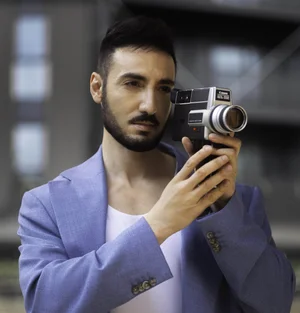
A Love Affair with Glass: A Conversation with Peter Layton from London Glassblowing
A Love Affair with Glass: A Conversation with Peter from London Glassblowing. A film by Aris Mercury
The first thing I noticed about Peter was his smile.
Not a polite gallery smile or the kind rehearsed through years of interviews, but a genuine warmth that appeared almost every time he spoke about glass, colour, experimentation, or the people around him. Before we even began, he apologised quietly and admitted he was not feeling “100%” that morning and worried he might not be much of a talker.
What followed became one of the most engaging conversations I have ever had with an artist.
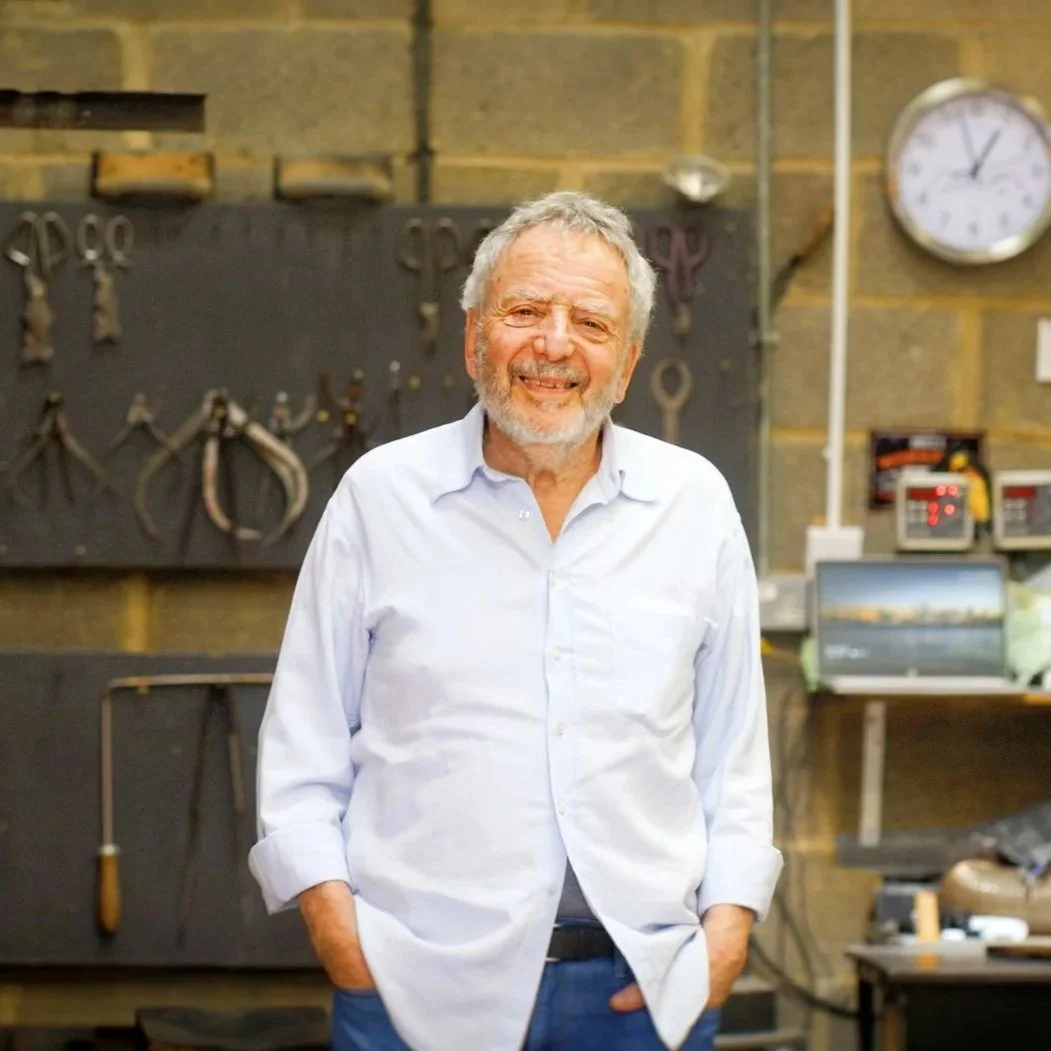
Peter Layton in his Bermondsey Studio - Photo by Aris Mercury
Throughout the morning, Peter moved constantly through the space at London Glassblowing — from the gallery to the hot studio, upstairs to the office and back down again, speaking with members of his team, checking pieces, answering questions, observing details. Even after nearly fifty years of building the studio, his involvement in the process feels total. Nothing about him suggests distance from the work.
What struck me most was not only his knowledge or the endless stories collected over decades of making, but also his curiosity. Peter listens carefully. He asks questions. He notices things. Even while sharing reflections about art, accidents, inspiration and survival, he remained deeply engaged with the people around him.
The studio itself feels alive in the same way ,part workshop, part gallery, part laboratory filled with heat, colour, sketches, experiments and pieces waiting somewhere between success and failure. For Peter, that uncertainty seems essential.
“At the outset, it was just a case of being in love,” he tells me. “It is a love affair with the medium, with the material.”
“We started in 1976 in Rotherhithe, right on the river,” Peter recalls. “We were literally on the edge of the water. At lunchtime we would sit on the wall and dangle our feet over.” The Thames became part of the studio’s imagination. In one early series, Flotsam and Jetsam, Peter used iridescent glass inspired by the oily colours and fragments floating on the water. “It was like an oil slick,” he says. “I used to look at that kind of thing floating on the Thames for inspiration.”
After fifteen years in Rotherhithe, the studio moved to the Leather Market before eventually settling in Bermondsey Street, where it remains today. The area around it has transformed over the decades, but Peter speaks about it with affection , the galleries, the restaurants, the Fashion and Textile Museum, and the atmosphere that slowly developed around the street.
“We’re glad to be here,” he says simply.
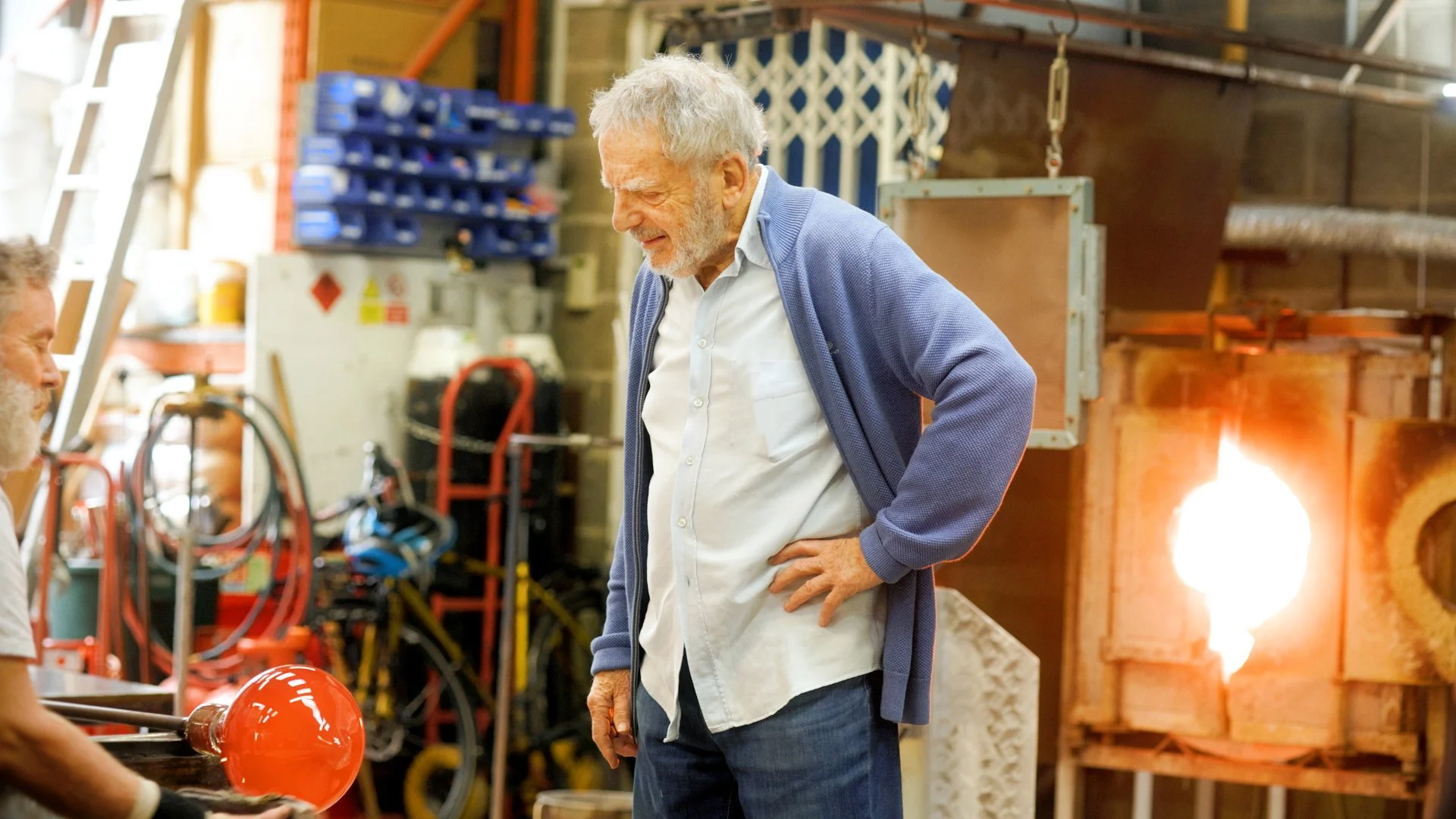
Peter Layton in his Bermondsey Studio - Photo by Aris Mercury
A Labour of Love
Looking back over five decades, Peter does not describe the beginning as a business plan or career strategy.
“It was a labour of love,” he says. “At the outset, it wasn’t necessarily about the money.”
The studio survived through teaching, experimentation, persistence and curiosity. Even now, Peter speaks less about achievement and more about learning.
“We were learning, and we still are. Constantly. That’s the most fun ,the experimental work. Trying new things, seeing what we prefer, resolving issues of scale, colour and form.” For Peter, glass is not simply a material to control. It is something to respond to.
“The exciting thing about glass is that it’s such a fluid medium. There is room for development at every stage. Sometimes we start with one idea, but because of the way the glass wants to move, we decide to make something else.”
That element of surprise remains central to the way he works.
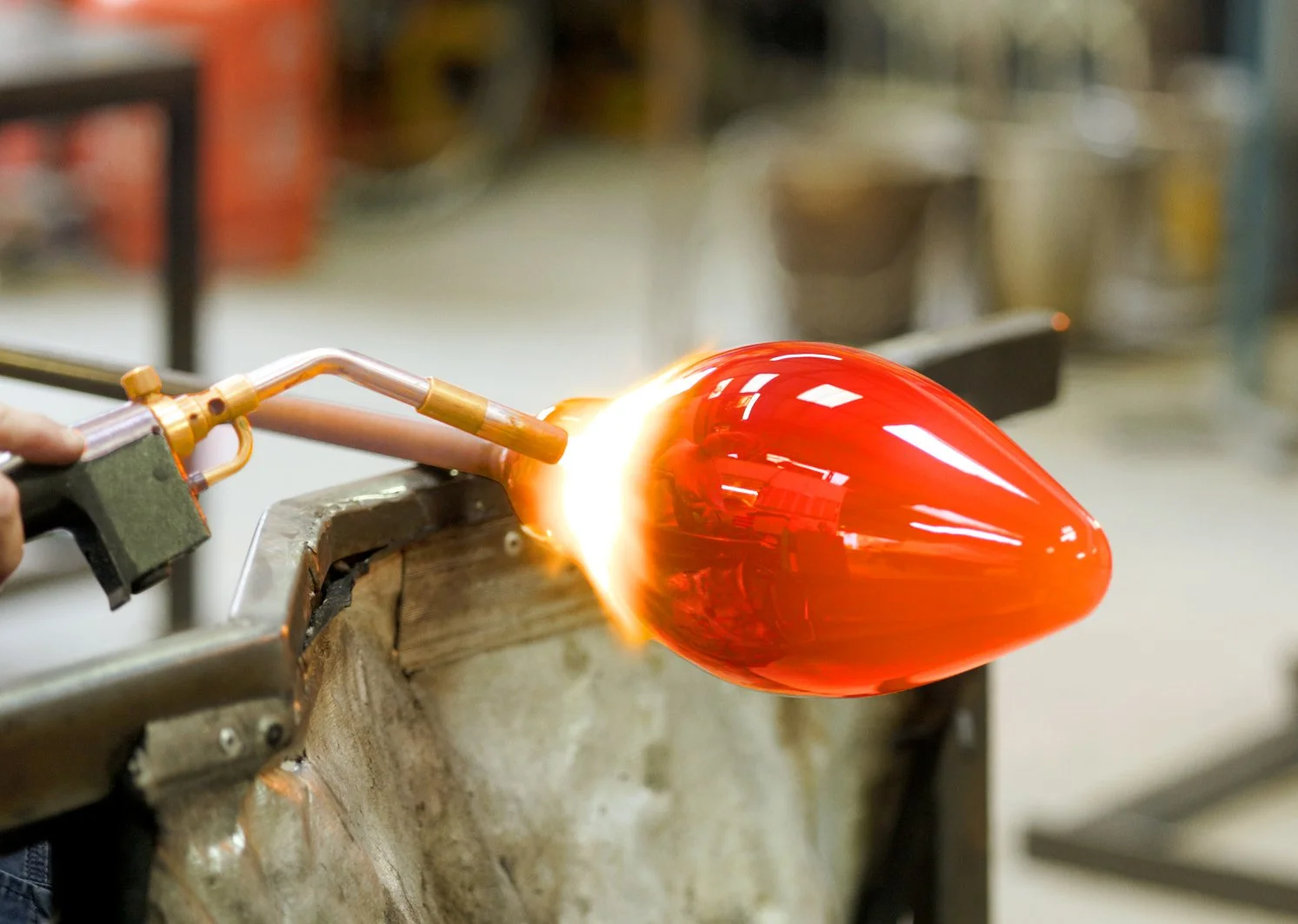
London Glassblowing Hot Studio - Photo by Aris Mercury
The Beauty of Difference
Peter’s work is not driven by perfection or repetition. “There are glass artists who want every detail to be precise, every piece to look the same. That isn’t our ethos. We are much more interested in making every piece different.” He laughs that perhaps this approach began because he was self-taught and “couldn’t make two things alike anyway,” but the point is serious.
“We want each piece to be unique. We work in series, but each piece is still a unique piece.”
For him, variation is not a flaw but evidence of life inside the process.
“Not every piece we make is a masterpiece. That’s what we’re striving for. But now and again, we get real gems. And along the way we make very good work, and we learn from all of it.”
Fire, Heat, and Movement
As a filmmaker, I often find myself multitasking while shooting , observing the space, studying the natural light, adjusting equipment, looking for the small moments that reveal something honest about the people and the environment around them. But while filming the glassmaking process at London Glassblowing, there was a moment when I simply stopped.
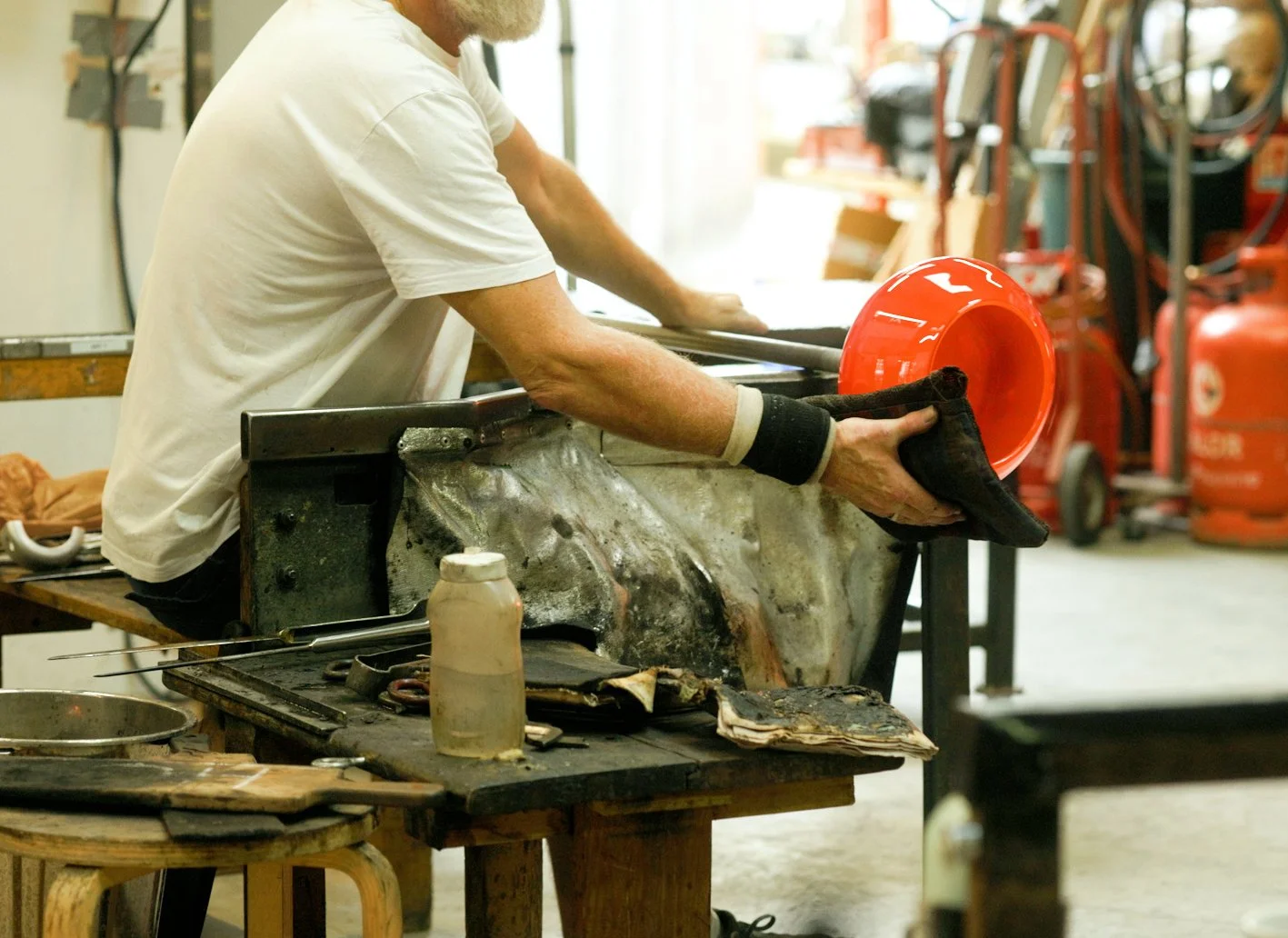
London Glassblowing Hot Studio - Photo by Aris Mercury
I found myself watching the molten glass turn and stretch at the end of the blowing iron, constantly changing shape in front of my eyes. The heat from the furnace, the smoke in the air, the glow of the fire, the reflections, the movement of the makers around the workshop , everything felt hypnotic.
There is something mesmerising about watching glass being formed. The material appears almost alive. Colours shift within seconds. Shapes emerge and disappear again. A piece can suddenly collapse, transform, or become something entirely unexpected.
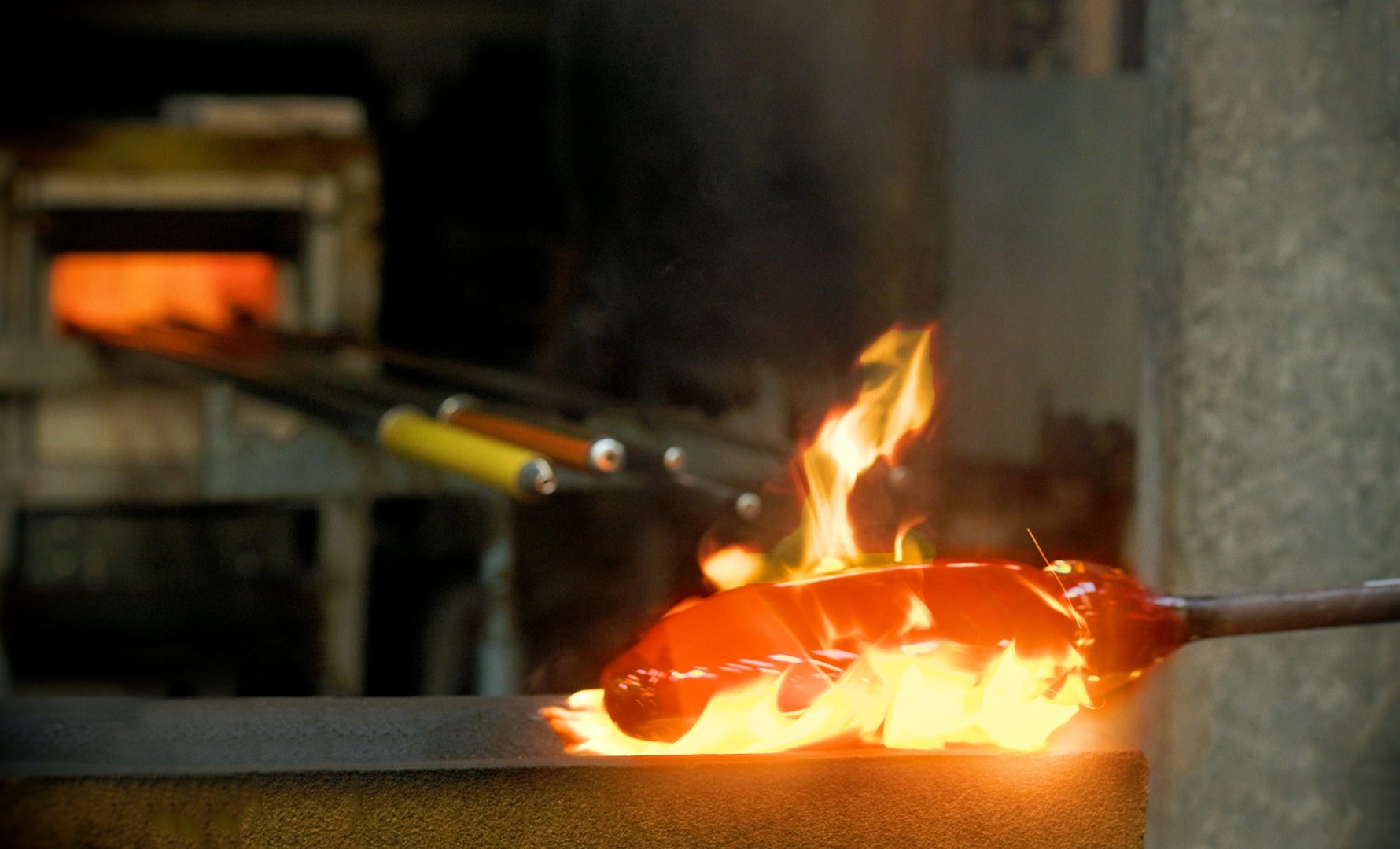
London Glassblowing Hot Studio - Photo by Aris Mercury
For a moment, it stopped feeling like documentation and felt more like watching a performance , a balance between control and chaos, precision and instinct. It became very easy to understand why someone could dedicate an entire lifetime to this process.
“Sometimes there’s an accident , not a serious accident , but something goes wrong, and those can be the qualities I love best.”
That unpredictability can make life difficult for the team around him. “They shudder,” he laughs, “because then I might turn around and say, ‘Gosh, let’s try and do that again.’” He describes the process almost as drawing directly in molten glass.
“I do have a sketchbook, and I do draw ideas. But a lot of the time it’s like sketching on the blowing iron ,moving, responding, reacting to what’s going on.” Even after a piece is finished, uncertainty remains. The glass must cool slowly in the annealing oven for days before the final result is revealed.
“It’s like opening a kiln if you’re a potter,” he says. “Sometimes it’s joy of joys, and other times it can be a disappointment. But even the pieces that aren’t quite what you hoped for, you learn something from them.
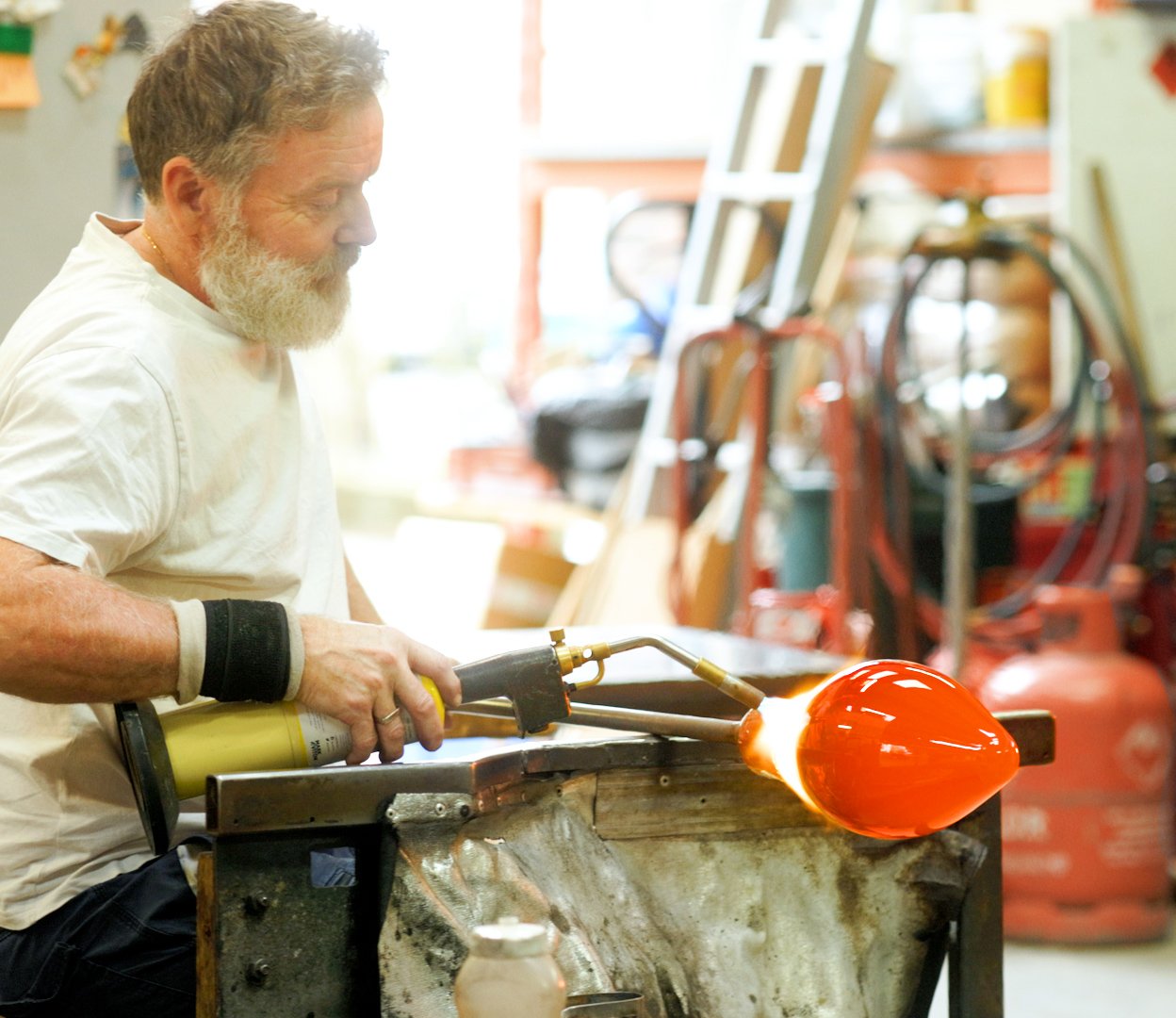
London Glassblowing Hot Studio - Photo by Aris Mercury
The Human Hand in an Age of AI
Peter believes people are increasingly drawn toward work that still carries evidence of human touch.
“As moulded plastics and AI overwhelm us , and even threaten us , I think there is definitely an interest in work that is more intuitive, that has evidence of somebody’s hands being involved.”
Imperfection, in this sense, becomes something valuable. “Symmetry isn’t necessarily a quality I’m interested in.”
The pieces reveal the movement of the material, the unpredictability of heat, and the decisions made in the moment by the people shaping it.
A Studio Built Around Collaboration
Although Peter’s name is closely connected to the studio, nothing about the environment feels centred around a single individual. “The guys that you’ve met downstairs, Louis and Bruce, we’ve worked together for many years,” he says. “We’re on the same wavelength about many things.”
During the interview, that connection was constantly visible. Peter spoke with almost every member of the studio while moving through the building, shifting naturally between conversation, observation, problem-solving and storytelling. Despite his experience and reputation, there was nothing detached about his role in the workshop. The studio still feels collaborative, curious and deeply hands-on. At one point he admits, almost casually, that he will turn ninety next year.
Yet throughout the day he moved through the studio with remarkable energy , discussing new colour combinations, checking experiments, carrying pieces, giving tours and speaking passionately about work still in development.
“I enjoy the development aspect of what we do,” he says. “That’s the bit that I get excited about , seeing a series evolve.”
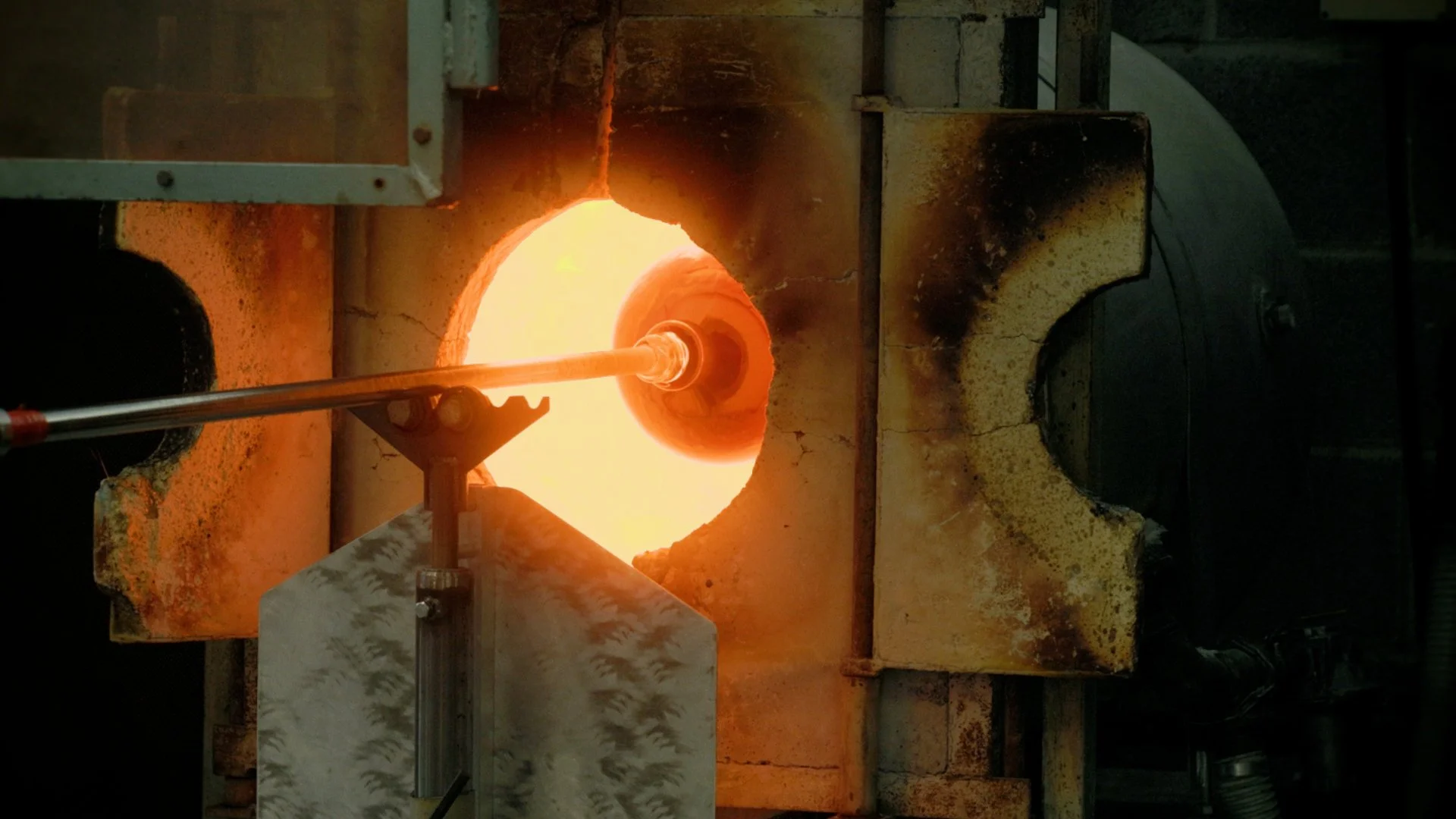
London Glassblowing Hot Studio - Photo by Aris Mercury
Inspired by Painters
Over the years, Peter has drawn inspiration from painters including Hockney, Van Gogh, Klimt and Howard Hodgkin.
For the Royal Academy, the studio created work inspired by David Hockney’s Arrival of Spring. For the National Gallery, they developed pieces responding to Van Gogh’s sunflowers. “We did hundreds of tests,” Peter says.
“We got so good at it that it looked as though we had painted the sunflowers onto the glass. So we had to step back ,not make it less good, but make it more glassy and less painterly.”
A Van Gogh-inspired piece unexpectedly led toward another direction entirely.
“I remember thinking one piece had more of a Klimt feel than a Van Gogh feel,” he recalls. “I showed it to an Austrian customer who was a Klimt fan, and he commissioned me to pursue five different versions inspired by Klimt.”
He became particularly fascinated by Klimt’s landscapes. “They’re fabulous,” he says. “Orchards and fields. Wonderful.”
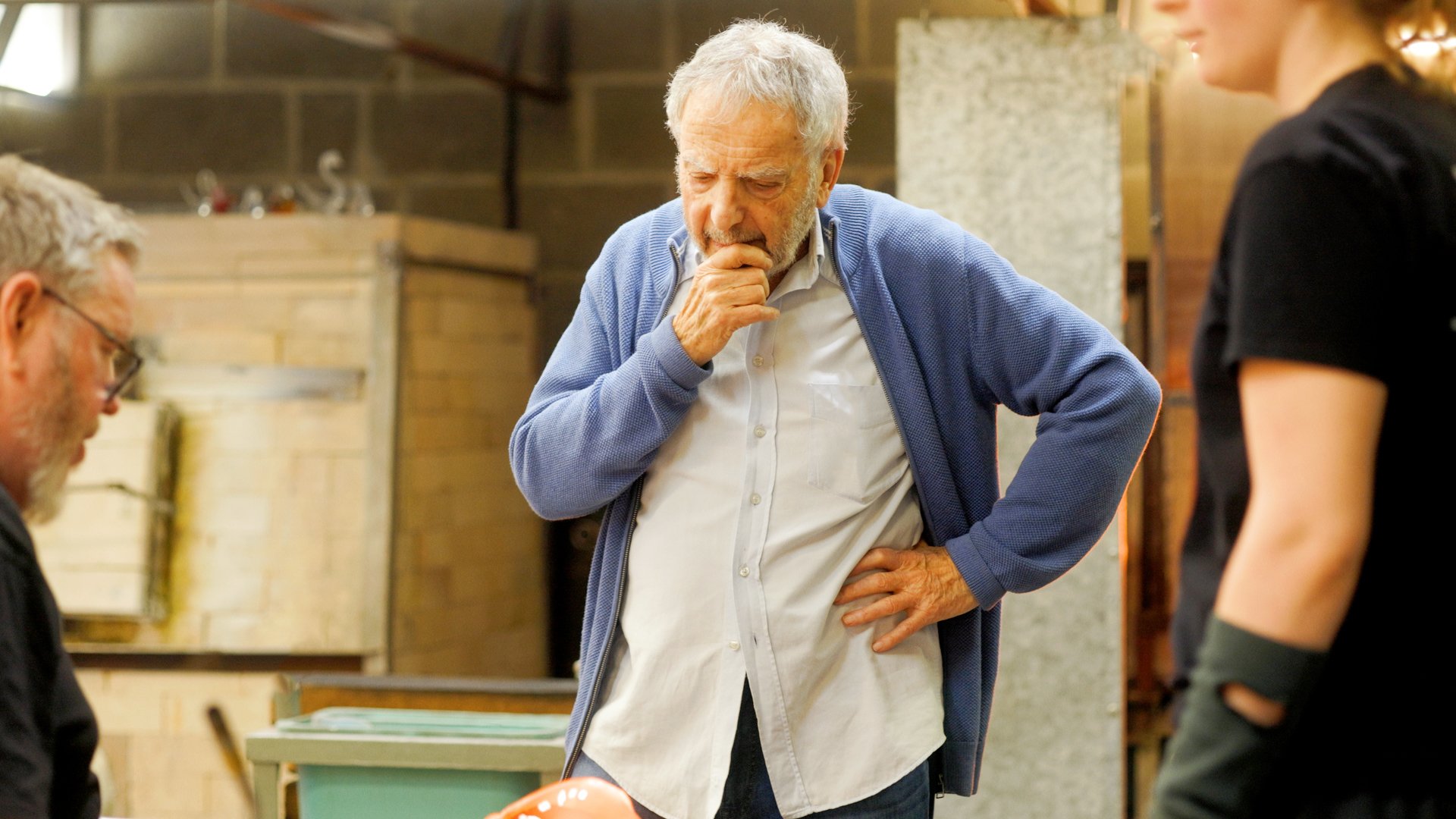
Peter Layton in his Bermondsey Studio - Photo by Aris Mercury
Waves, Clouds, and Frozen Movement
Some ideas continue returning throughout Peter’s work. Waves are one of them. After visiting Japan, he became fascinated by Hokusai’s Great Wave. “The wonderful thing about those waves is that quality of frozen movement,” he explains. “That is very fundamental to glass, because it does freeze at a certain point. It is a molten material which becomes a solid.”
Years later he returned to the idea, creating standing waves, barrel waves and new variations inspired partly by the sea and partly by his son’s love of surfing. Clouds became another recurring theme. “I quite like these ephemeral things that are crazy to capture,” he says.
Glass, for Peter, often seems to become a way of preserving temporary things — movement, atmosphere, weather, light — turning something fleeting into something solid.
Still Curious After Fifty Years
Running a glass studio in London is not easy. Peter speaks openly about rising costs, uncertainty, energy use and the difficulty of sustaining handmade work in a modern city. “The costs are ridiculous,” he says. “We shouldn’t still be in business, actually. But somehow we survive.” Part of that future now rests with the next generation. His son-in-law, Tim Rawlinson, works in the studio, while his daughter Sophie brings her own artistic and commercial strengths to the business.
Still, Peter himself remains deeply involved.
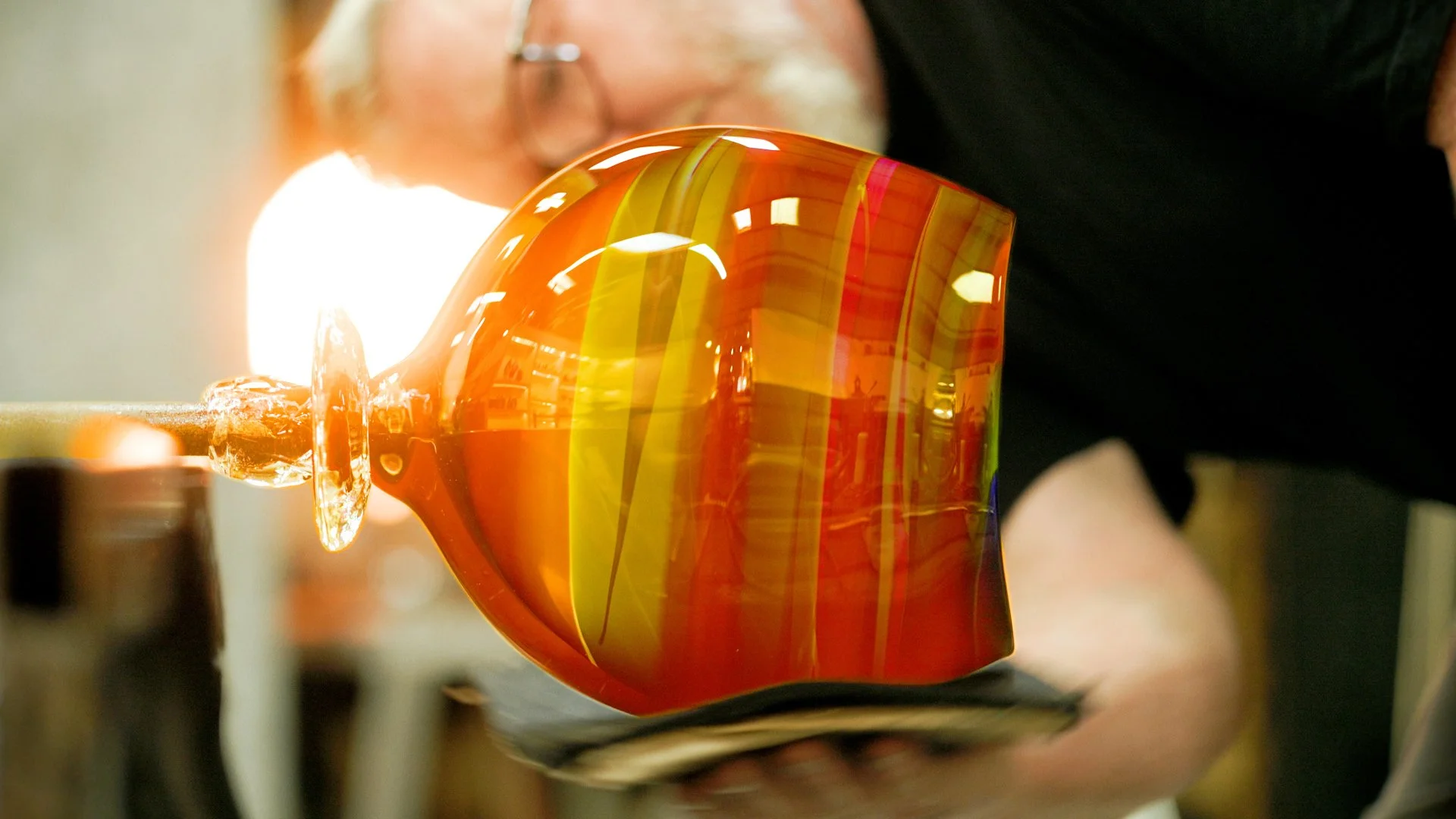
London Glassblowing Hot Studio - Photo by Aris Mercury
Leaving the Studio
I ended up spending nearly four hours at London Glassblowing, although it never felt that long.
By the end of the day, I wanted to properly thank Peter and say goodbye, but finding a quiet moment proved almost impossible. He was constantly in motion , speaking with members of his team, greeting people walking into the gallery, chatting with neighbours and local business owners, moving naturally between conversations with the same curiosity and enthusiasm he brought to the work itself.
At one point, with genuine excitement, he introduced me to a Michelin-starred chef he had recently begun collaborating with. Within minutes, the conversation moved from glass to food, from London to Greece and Spain, and eventually to shared memories of Folegandros ,an island we had both visited and loved. It felt strangely fitting.
After hours of speaking about experimentation, movement, accidents, art, travel, people and ideas, the conversation still continued effortlessly into something new. When I finally left the studio and said goodbye to Peter, I realised I was leaving with the same feeling that seems to drive both him and the space around him: curiosity. Excitement about life. The desire to keep discovering, observing and creating.
And perhaps that is the real energy behind London Glassblowing after all these years.
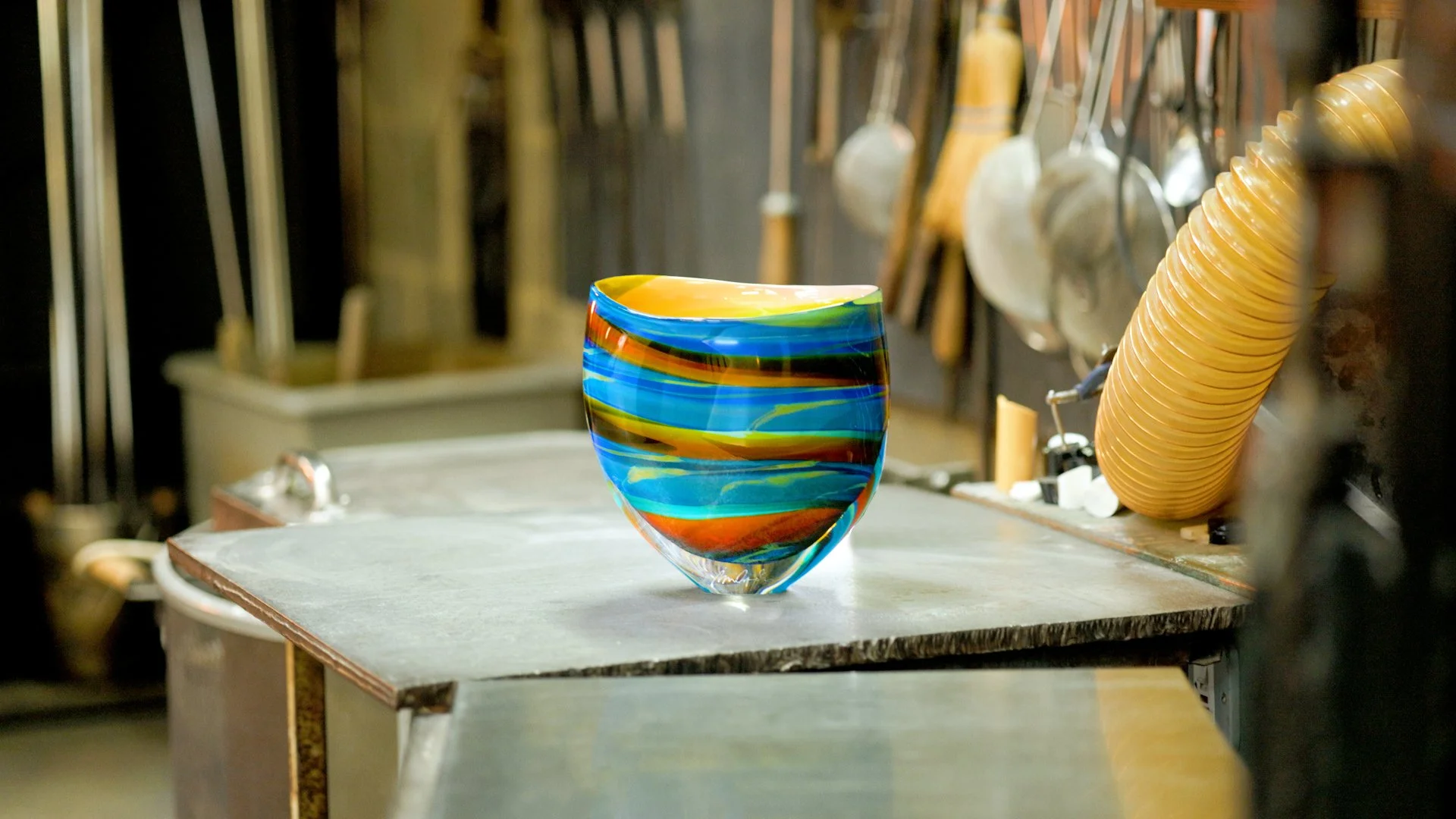
Of Hands and Heart is a documentary series by London-based filmmaker Aris Mercury, exploring artists, artisans, makers, and people whose work carries history, skill, and personal meaning.
Some shape objects with their hands; others care for places, tools, machines, or practices that have existed for generations. What makes each story unique is not only the work itself, but the person behind it: their character, memories, discipline, and the personal way they bring meaning to what they do.
These films are made to slow down, observe, and reveal something honest about craft, heritage, beauty, and the people who keep meaningful work alive.