Inside London Stone Carving: Dust, Patience, and the Value of Making by Hand
Inside London Stone Carving: Dust, Patience, and the Value of Making by Hand. A film by Aris Mercury.
I visited Josh at London Stone Carving to film him in his studio and talk about his work, his process, and what it means to spend your life making things slowly by hand. He and Tom Nicholls have been in that space for 10 years. Yeah, 10 years,” he told me.
“It’s gone quickly.” The space was full of tools, unfinished pieces, leftover objects from past projects, bits of stone,
dust, models, and things in progress. Not in a styled or designed way, just in the natural way a real working
studio becomes itself after years of use.
A space built for noise and mess
One thing Josh made clear very quickly is that stone carving needs a very particular kind of space.
When I mentioned how quiet it was, he laughed a bit and said it is not usually like that.
“When we’re underway with the projects, it tends to be quite a lot of power tools, drilling and grinding and dust extraction,” he said. “So it can often be quite noisy in here.”
He described the workshop as a semi-industrial space, and said that is essential for the kind of work they do. Stone carving is not something you can easily fit into a clean shared studio environment.
“One of the prerequisite things really is having somewhere that you can get away with noise and mess,” he said.
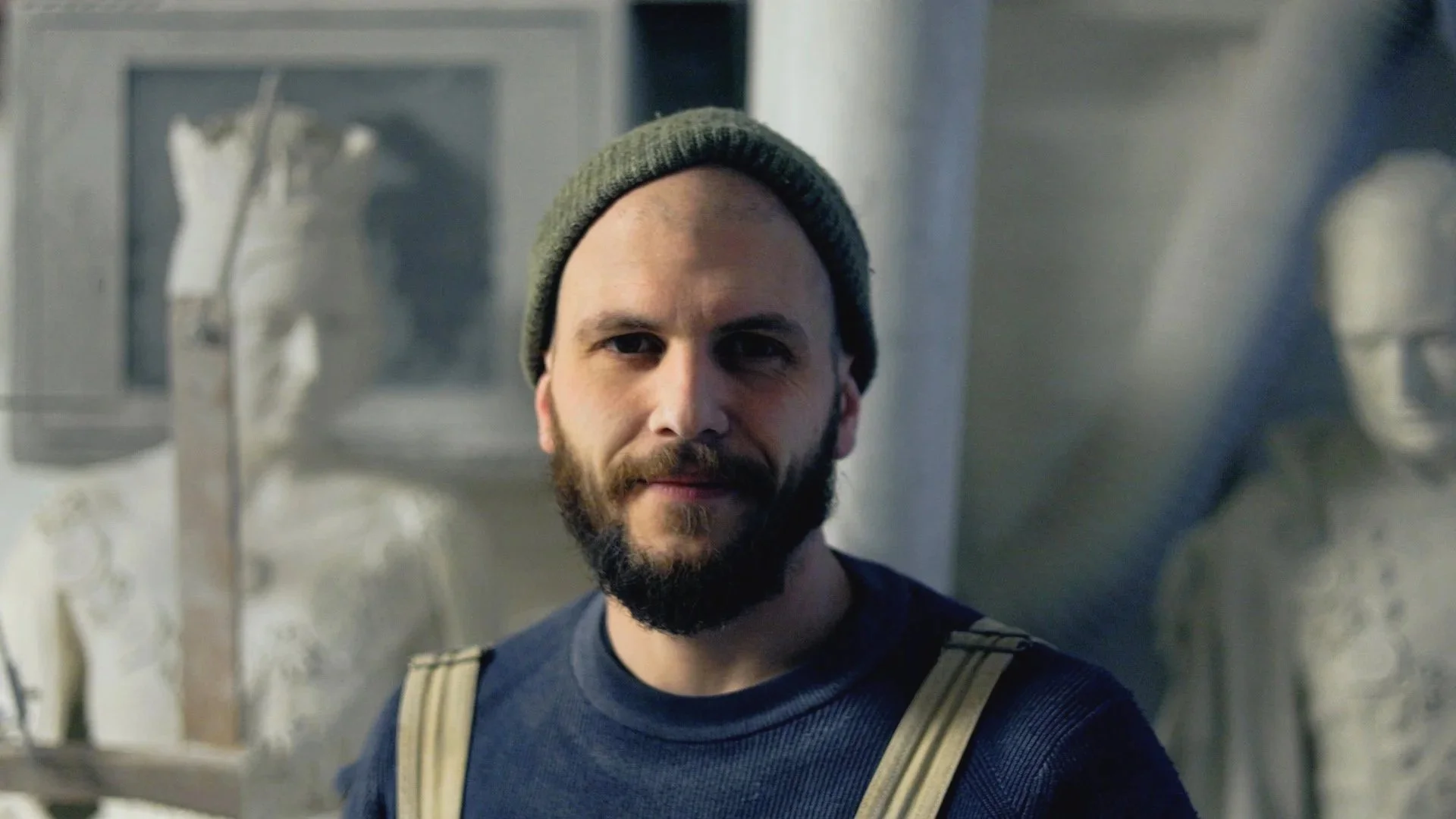
Josh Locksmith in his Studio in London - Photo by Aris Mercury
As we talked more, Josh explained why unfinished pieces are such a normal part of the studio. Stone takes time. A lot of time. And that changes everything.
“Everything in stone tends to take weeks or months to make really,” he said.
That means every decision carries weight. If you are making something for yourself, without a buyer already waiting for it, there is always a balance between wanting to make something interesting and wanting to work efficiently. But stone does not forgive uncertainty very easily.
“You can’t stick things back on,” he said. “You can only make it smaller.”
That is probably one of the clearest descriptions of the material. Stone carving is not only skill. It is commitment. It asks you to think ahead, and then still stay flexible enough to respond to what the material gives you.
For commissioned work, they usually make a clay model first. That allows them and the client to test the form, change details, and solve problems before moving into stone.
“You can sort of push it and pull it and figure out the form in the clay,” he said.
That model then becomes the guide for the final carving. It is a way of reducing risk, but also a way of understanding the piece more deeply before committing to the final material.
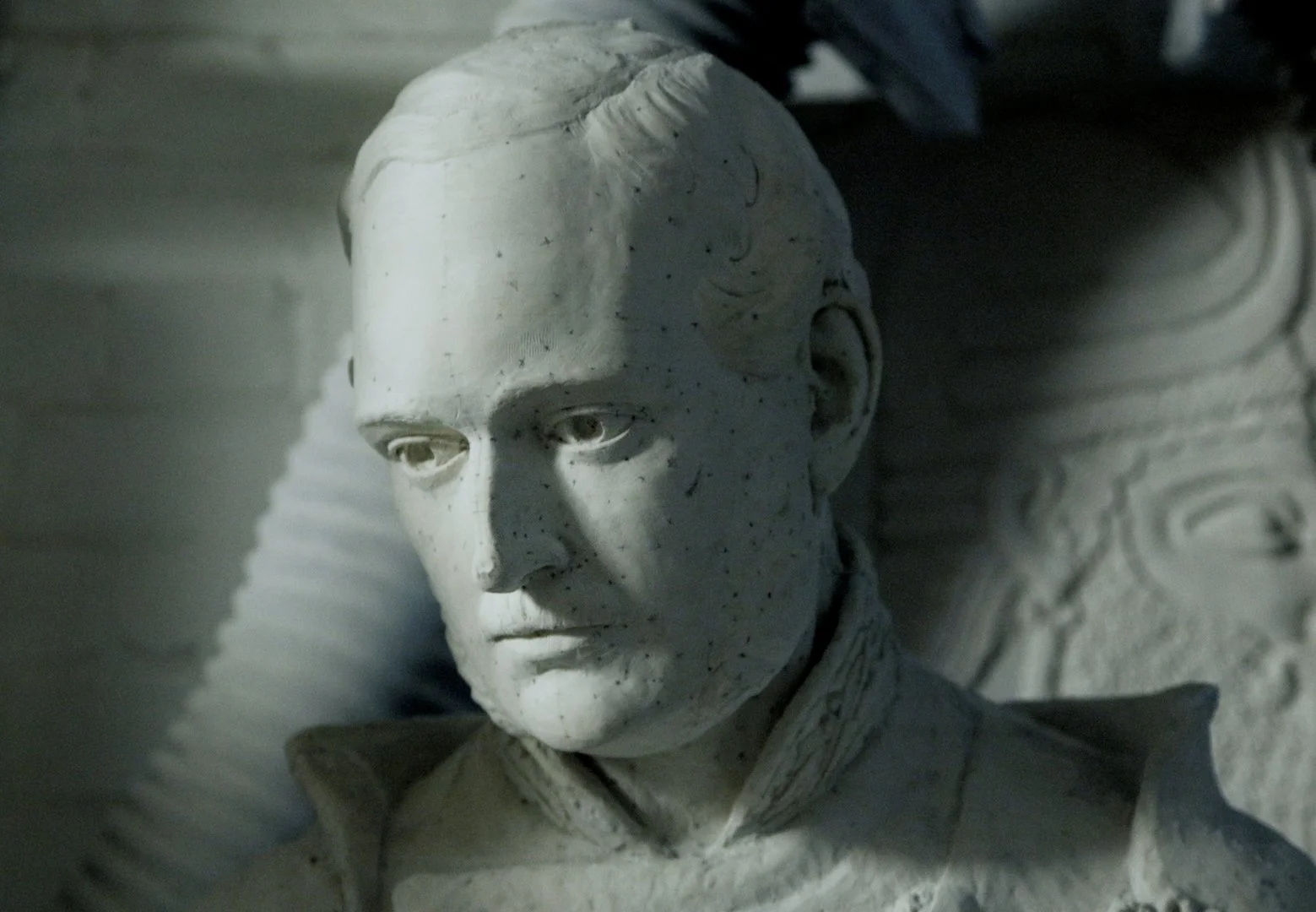
One of the clay models for their work for Royal Albert Hall - Photo by Aris Mercury
Historic craft, contemporary work
Josh explained that they originally trained in historic carving , studying styles, techniques, and methods from different periods, often connected to the restoration of historic buildings and sculpture.
A lot of that work is in and around London, and much of it involves British stone, especially Portland stone.
“Most stone buildings in London tend to be Portland,” he said.
He described it as reliable, not too hard and not too soft, able to take detail well, and strong enough to survive outside for centuries.
“If you stick a statue on a building, you could sort of hope that it’ll last at least a few hundred years,” he said.
At the same time, the studio’s work is not limited to one style or one kind of commission. They work with artists, architects, designers, and restorers, using materials from Britain and across Europe depending on the project.
That variety seems important to him.
“You’re never really doing the same thing one week to the next,” he said.
And maybe that is part of what keeps the work alive: moving between historic and contemporary, between restoration and invention, between technical precision and artistic interpretation.
Why they still work by hand
I mentioned to Josh that I still remember learning as a child at school in Greece that stone carving was one of the most ancient crafts. I asked whether he had seen techniques changing through the years. His answer was thoughtful.
Of course the wider stone industry is becoming more mechanised, with CNC machines and computer-led production playing a bigger role. But their own practice still stays close to the handmade. “We didn’t really get into this because we wanted to be business people,” he said.
“We got into it because we love making beautiful things.”
That felt like the heart of it.
He did not reject technology in an overly rigid way. In fact, he spoke quite openly about the pressure of automation and the practical benefits it can bring. But he also spoke about the risk that something can stop being a workshop and start becoming more like a factory.
“I think we’d all kind of worry that we’d lose touch with that role of maker,” he said.
For him, part of the satisfaction comes from following the whole process through: designing, making, installing, seeing the object arrive fully in the world through your own hands.
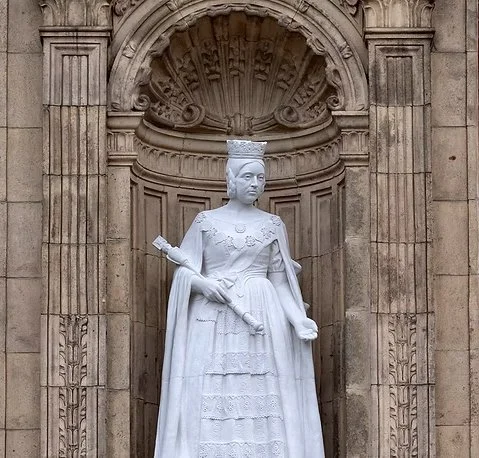
One of the finished pieces at the facade of Royal Albert Hall Photo from www.londonstonecarving.com
“There’s an enormous amount of satisfaction,” he said, “from seeing that whole process through in-house.”
The personality of stone
One of the most beautiful things Josh said was that each block of stone has its own personality.
Even when it is the same material, each piece behaves differently. The colour varies. The density changes. Unexpected shells, faults, soft patches, or darker marks can appear inside it. A beautiful piece can suddenly reveal a flaw in the wrong place. Or a stone can surprise you in a good way and become more interesting than you expected.
“You’re never truly in control of the final look of the piece,” he said.
That seems central to the practice. Stone carving requires planning and control, but it also requires acceptance. You are always collaborating with geology, with time, and with something older than yourself.
As he put it, “You’re at the mercy of millions of years of geology.” That line says a lot. It captures both the humility and the challenge of the work.

The exterior of Royal Albert Hall with the two sculptures that London Stone Carving created. Photo from https://www.londonstonecarving.com/
The alabaster piece
One of the pieces he showed me was made from English alabaster and it was designed by Mexican artist Ricardo Mondragon . At first glance it looked simple, but Josh explained that it was actually one of the most subtle and demanding things he had worked on.
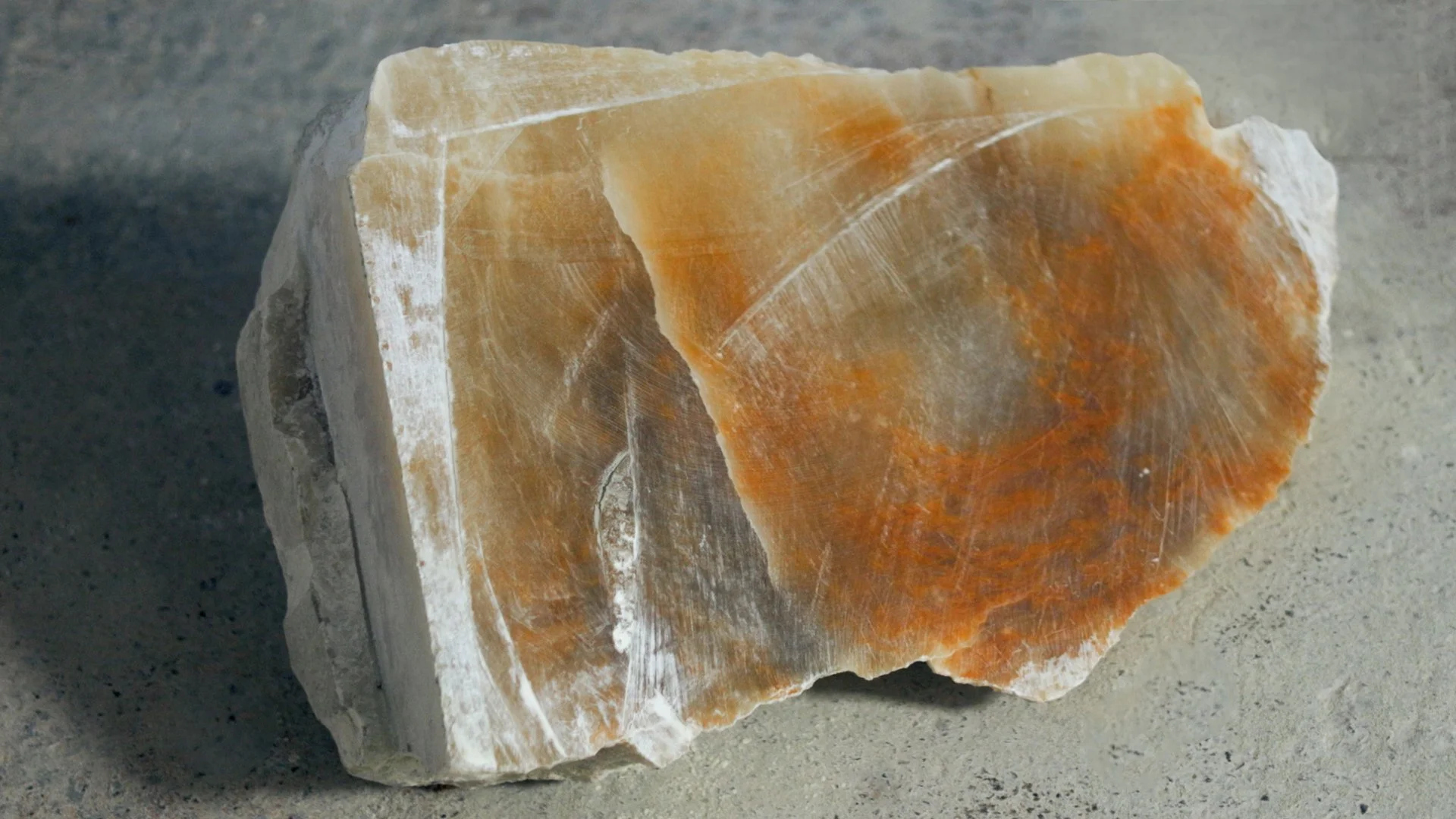
One of the raw alabaster pieces inside the studio . Photo by Aris Mercury
“Everything’s a curve and every curve informs another curve,” he said.
That meant the whole piece was unforgiving. If one part was slightly wrong, the next part would be wrong too. And because the carving had become very thin and delicate, the material also became more fragile the further it progressed.
He told me the piece had started as a 200-kilogram boulder and had gradually been reduced to something closer to 10 or 15 kilograms.
What interested him about alabaster was not only its softness and workability, but also its translucency.
“It’s also got this lovely translucency,” he said. “You can start to see the light shining through it in places.”
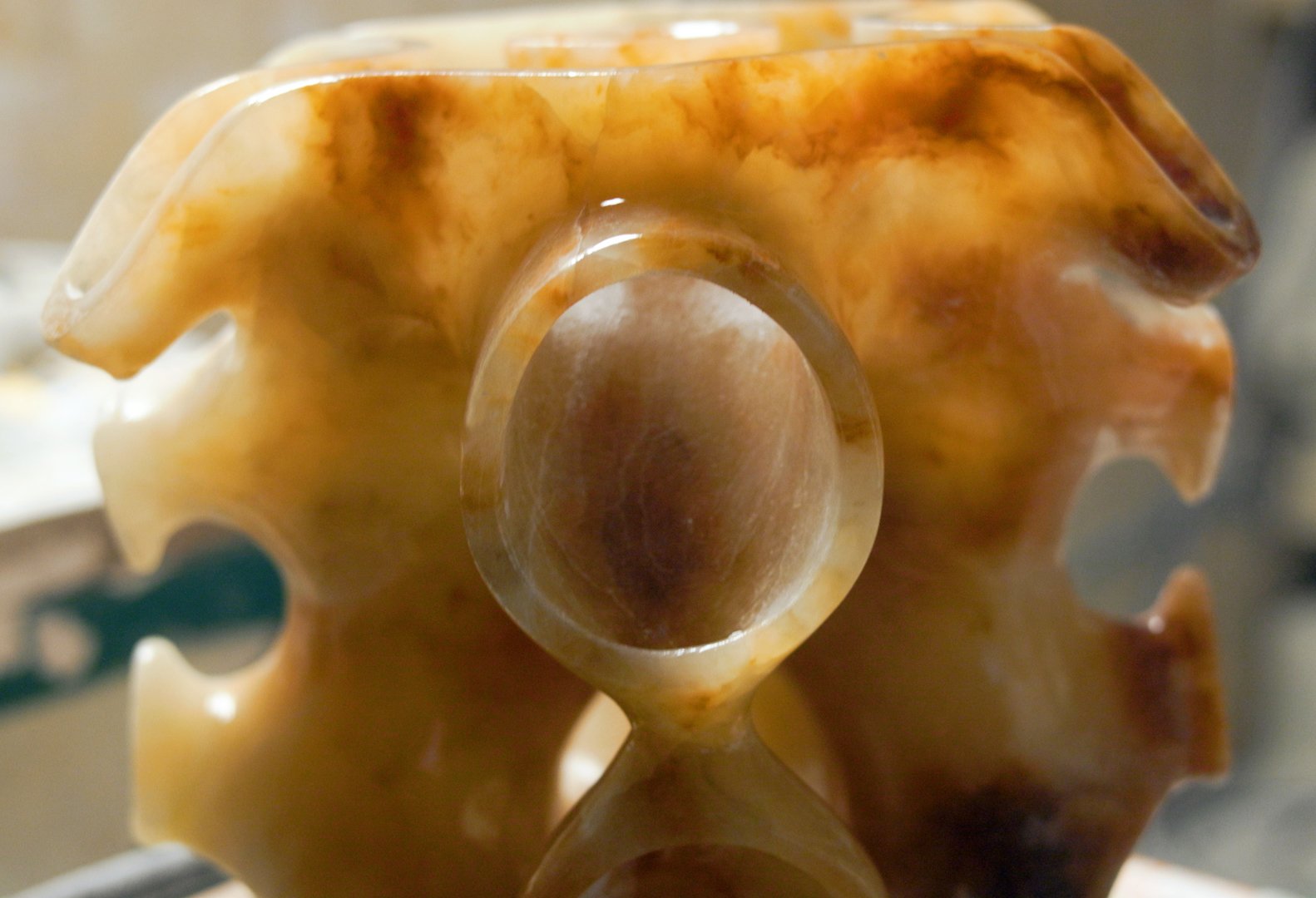
The alabaster sculpture Josh was working on during filming was designed by Mexican artist Ricardo Mondragon . Photo by Aris Mercury
When he wet the surface slightly, the colour deepened and the material came alive. He compared it to deep-space photography clouds, patterns, something almost cosmic inside the stone.
‘‘That was one of those moments where the material stopped feeling like a raw block and started feeling almost luminous.’’
Precision, instinct, and not rushing
Josh also showed me the pointing machine they use for larger figurative work , a traditional measuring device that helps transfer a sculpture from model to stone. The process sounded methodical, almost architectural, but he made clear that technique alone is not enough.
“You constantly have to trust your eye as well,” he said.
That balance between system and instinct seems to define a lot of what they do. There are tools, methods, measurements, and rules but there is also judgement. You have to work slowly, carefully, and layer by layer.
“The trick is to not rush,” he said.
That sentence could probably stand for the whole practice.
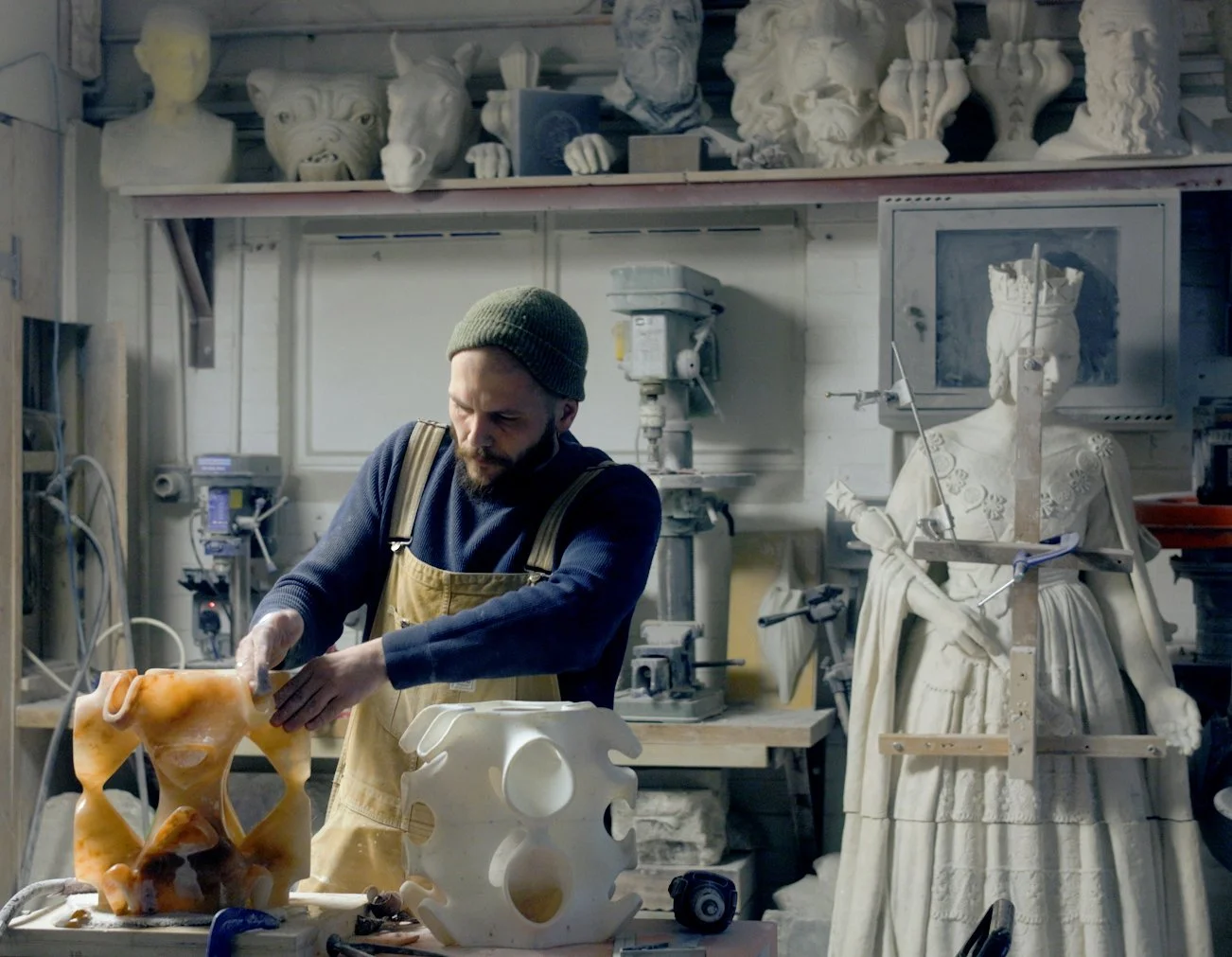
The alabaster sculpture Josh was working on during filming was designed by Mexican artist Ricardo Mondragon . Photo by Aris Mercury
Because even with all the tools and all the experience, mistakes are always possible. The material can surprise you. A hidden mark can appear. Something can shift. And in some kinds of carving, especially portraiture, there is very little room to improvise once something goes wrong.
Sometimes, he said, you simply have to start again.
What remains valuable
In a world moving more and more towards speed, automation, and surface-level efficiency, there is something powerful about a practice that still depends on touch, patience, weight, dust, repetition, and judgement.
Josh said he believes there will always be people who want things made by hand.
“There’s still gonna be a pocket of people that want to invest in people,” he said, “because of the personality and energy and soul that you put into something when it’s made by hand.”
And standing in that dusty studio, surrounded by tools, stone offcuts, unfinished forms, and years of work, that felt completely true.
By the time I left the London Stone Carving workshop, there were layers of stone dust covering my clothes, my shoes and even my filming equipment. Normally that might feel inconvenient, but there it felt strangely beautiful. Appropriate, somehow. Like evidence that I had stepped inside the process itself for a few hours.
Of Hands and Heart is a documentary series by London-based filmmaker Aris Mercury, exploring artists, artisans, makers, and people whose work carries history, skill, and personal meaning.
Some shape objects with their hands; others care for places, tools, machines, or practices that have existed for generations. What makes each story unique is not only the work itself, but the person behind it: their character, memories, discipline, and the personal way they bring meaning to what they do.
These films are made to slow down, observe, and reveal something honest about craft, heritage, beauty, and the people who keep meaningful work alive.